How to make a Government Consultation Accessible
Running a workshop on the Greater Cambridge Development Coorporation
Introduction
In February and March 2026 the government ran a public consultation seeking views on the establishment of a centrally led development corporation for the Greater Cambridge region.
Cambridge and its immediate surroundings have been identified by the national government as a potential ‘engine’ for national economic growth and the establishment of a centrally led Development Corporation (DevCo) would be the key driver to facilitate this. It would also be at the centre of a potential clash between national and regional government, even with, or perhaps especially with the planned changes to local government.
The Cambridge Room is a charity set up specifically to form connections between local people and all the parties involved in shaping the built environment. That includes trades people, designers, planners, developers, specialists, academics, politicians and more. One of our charitable objectives is to encourage public engagement in democratic processes like consultations and as such it was important that we worked hard to connect local people to the government’s questions.
We did this in 3 ways
· A ‘Let’s Talk About’ event with key players in the process and a participating audience
· A Workshop looking at the consultation questions and format itself
· A Briefing note available on our website summarising issues arising from the process
This blog looks at how we structured the workshop and reflects on the lessons learned for future engagements.
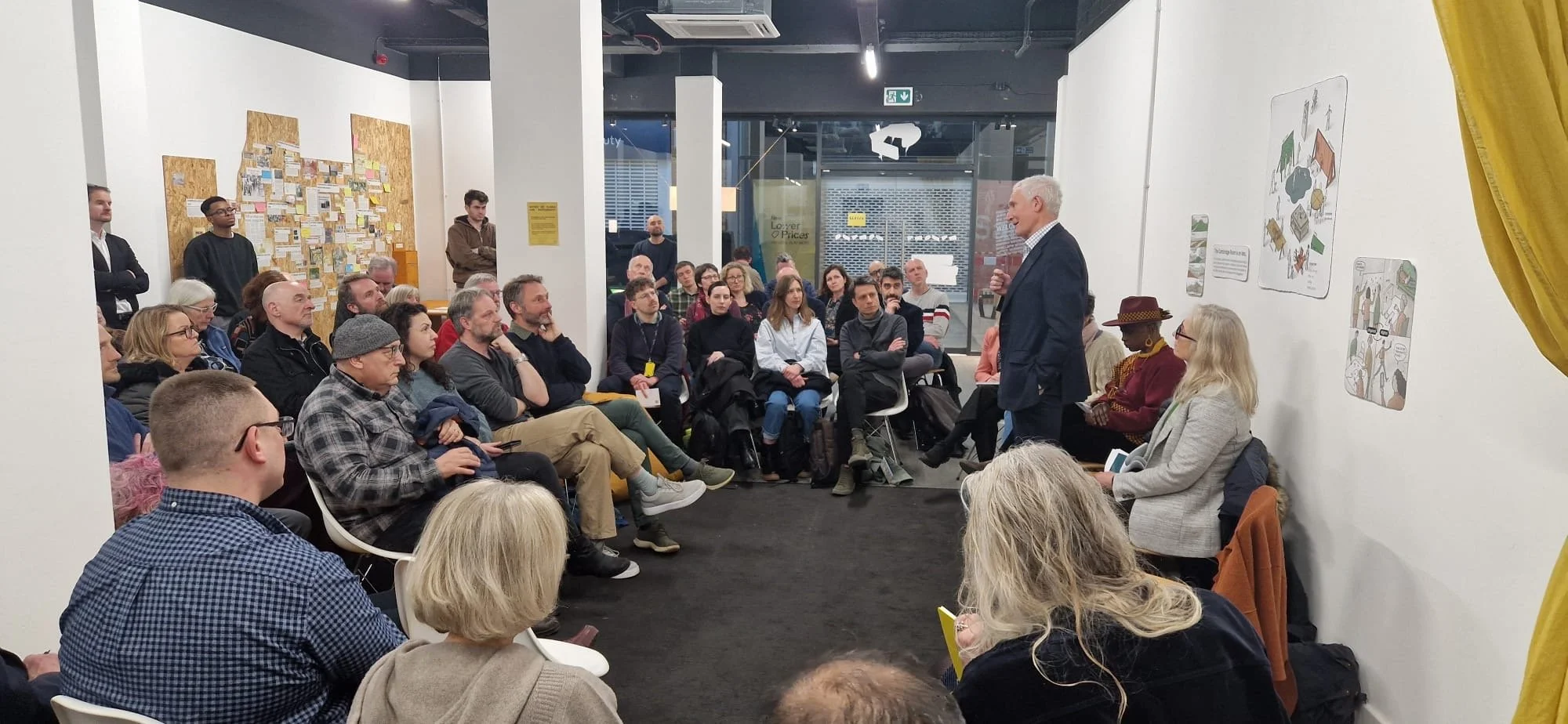
Peter Freeman, Chair of The Cambridge Growth Company, speaks at “Let’s Talk About the DevCo” Cambridge Room event
Workshop format
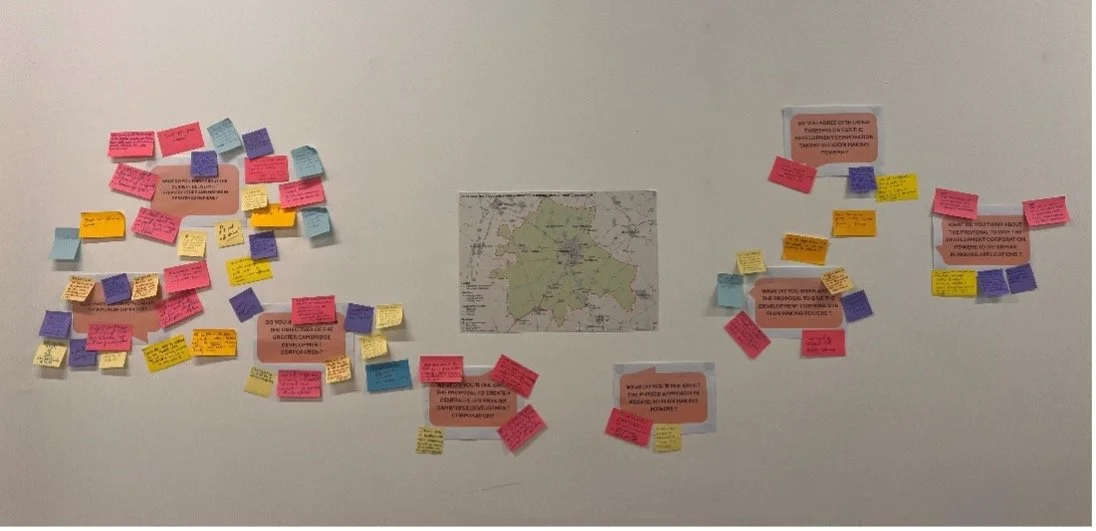
The workshop took place in The Cambridge Room, a pop-up space in the shopping centre, The Grafton, which is on the cusp of transforming into a centre of laboratories and retail. The room was set up with small groupings of tables and chairs, a large screen for presenting and a wall space with a central map and key questions for interactions. It ran from 5pm to 7pm on a Monday.
14 people attended, some built environment specialists, some locals and some academics. Outcomes were measured loosely with a show of hands as to how likely attendees felt they were to answer the online questionnaire at the beginning and then the end of the workshop. The result was an increase of some 300%.
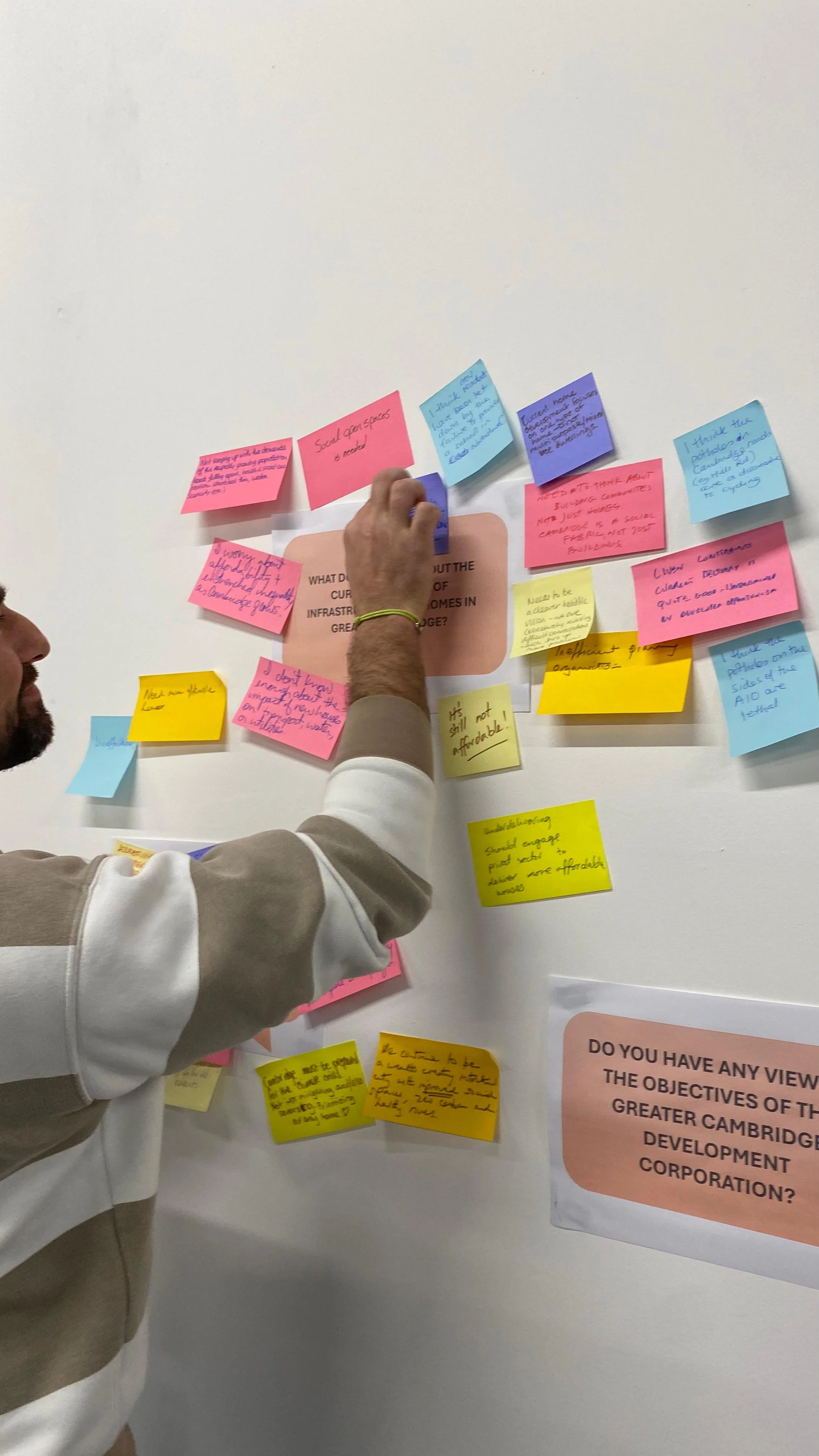
As presenter, I took everyone through the essence of the consultation using a power point presentation and included a number of opportunities for attendees to interact in small groups. I stressed that it was up to individuals to respond to the consultation after the event but invited them to write responses to questions on post-its, as we discussed them, and to stick them on the wall. This was designed to free up people’s thinking and to allow a space for instinctive or unstructured responses. I explained that we would not be processing any of the answers on the wall but that we wanted to keep the result for the duration of the consultation as an installation in the Cambridge Room.
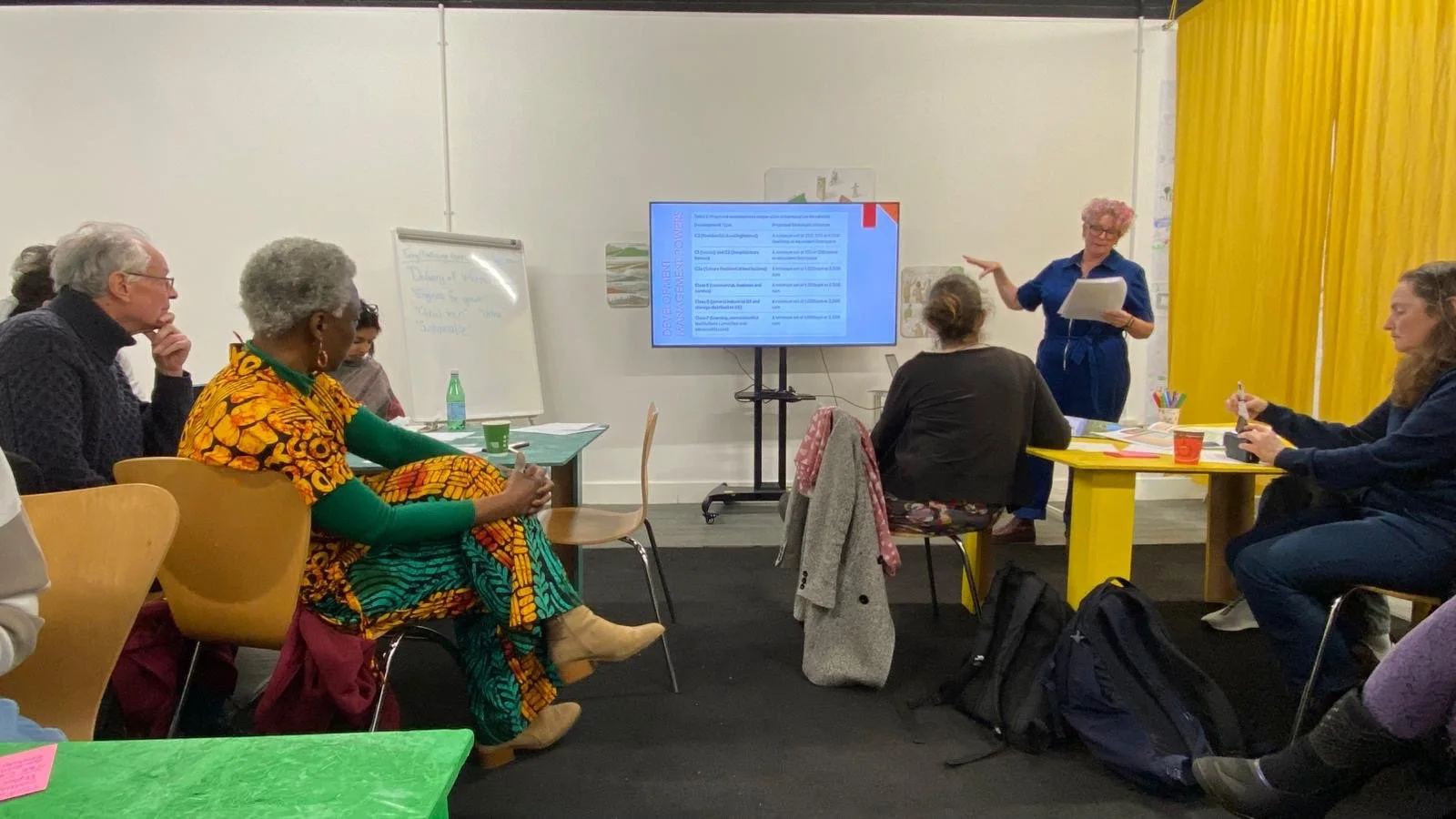
Jo Hobohm presents the consultation workshop
Together with post graduate planning expert, Aarushi Ganguly, our role was as guide and translator. We stressed our neutrality and this was helpful when navigating the strong emotions that some of the issues inevitably sparked. As might be expected, the documentation was wordy, quite long and used specialist language. Slides were deliberately used bold and colourful and broke the information down as follows:
1. How to respond, links to the online documentation, what to expect, what the website looked like
2. The mechanics of the survey: questions could be left blank, users could navigate forward and backward, save for later and personal information was not requested
3. Issue of language – the same word can have different meanings to different people. Use group activity to illustrate this and reflect on examples in the document. Checking meaning for some terminology and discussing document’s use of deliberate ambiguity.
4. Highlight the gist of each main section of the document and then the question related to it. Invite post-it responses
5. Take a break!
6. Encourage group discussion, pull out particular phrases that might need clarification, allow broader discussions across the room without losing momentum.
Lessons learned
Attendees were engaged and responsive and sitting at tables allowed quieter individuals to join the conversation in contrast perhaps, to our larger ‘Let’s Talk About’ event. There was a good level of participation in group activities and a mixture of some humour and moving around the room helped diffuse what could otherwise have been 2 hours of very dry ‘lecturing’.
Although the duration may have put some attendees off, when combined with the informality of the workshop, it seemed to allow time to draw out the variety of backgrounds and views of the people in the room. In this way it was clear people were engaging with others who were not their normal peers: people younger, or older than themselves, people with different priorities, different skills and different experiences of the region.
Although the number of attendees was certainly high enough to achieve a good sense of involvement and atmosphere it would have been gratifying to reach more people. This would probably require more targeted marketing over a longer period than we actually had and hopefully some word-of-mouth momentum as this was our first consultation workshop. The work to prepare the presentation was extensive and it is a challenge to do so whilst remaining neutral on some of the content. However, this is vital if the Cambridge Room is to maintain a reputation as a place for conversation and connection across the boundaries that exist in the built environment field.
One biproduct of the process was the increase of my own level of expertise on the subject and this proved very useful at subsequent events in The Cambridge Room when the topic of the DevCo arose. The process also highlighted how some language and terminology can be a barrier to people who do not commonly talk about the built environment. It would be most rewarding if this learning could be fed back to the teams assembling consultations like these in the first place.
Finally, we await the outcome of this government consultation. If we are to make consultations like these meaningful to all local people, it will be important that the outcomes are fed back to everyone in an equally engaging and accessible way and The Cambridge Room will lead the way.
With thanks to Aarushi for her focused interrogation of the material, Eve Toomey for input on group dynamics and Negar Shirazi for photos.